When city lights are no longer just an accent for the night, but a single streetlight integrates lighting, monitoring, communication, and charging—smart streetlights have long surpassed the boundaries of traditional lighting, becoming a core infrastructure of smart city development and a crucial convergence point for the global “dual carbon” goals and digital infrastructure construction. Supported by data from authoritative industry research reports, we can clearly see that this sector is experiencing explosive growth, while the strategies of leading companies are defining the industry’s future trajectory.
According to the latest report released in 2024 by IoT analytics firm Berg Insight, the global installed base of smart streetlights is undergoing explosive growth. The report indicates that the global smart streetlight market is in a golden period of high-speed growth. By the end of 2022, the global installed base of independently controlled smart streetlights had reached 23 million units, and it is projected to surge to 63.8 million units by 2027, representing a remarkable compound annual growth rate (CAGR) of 22.7%.
22.7%—a figure that is astonishing in any mature infrastructure sector. Underpinning this growth rate is a renewed recognition by city administrators regarding energy efficiency, operational costs, and the value of data.
Another set of authoritative data from Research and Markets further confirms the industry's explosive potential from a market size perspective: the global smart streetlight market is estimated to be approximately $2.96 billion in 2025, projected to grow to $3.56 billion in 2026, with a CAGR of 20.4%, and is expected to surpass $7.49 billion by 2030, maintaining a trajectory of high-speed growth. On a regional level, Europe, as a leading adopter of smart streetlights globally, currently accounts for about 35% of the global installed base. North America is the fastest-growing region, while the Asia-Pacific region, driven by intensive smart city construction, is rapidly emerging as a key global growth pole, with deployments in countries such as China and India growing at an average annual rate of over 25%.
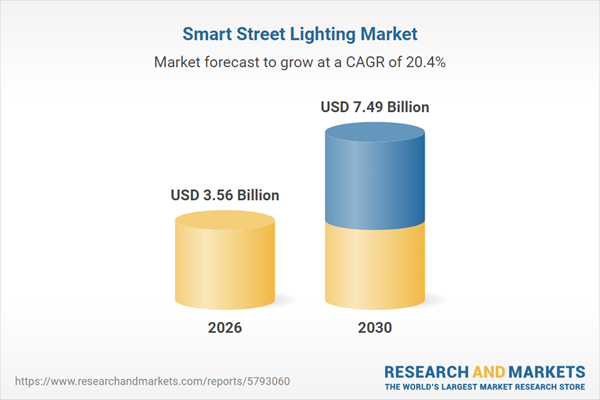
Image source:Research and Markets
Behind these figures lie profound shifts in industry demand and continuous technological iteration. Traditional streetlights have long faced three major pain points: energy inefficiency, low operational efficiency, and single functionality. High-pressure sodium lamps suffer from poor energy efficiency, and the common phenomenon of lights “remaining fully lit even when no one is around late at night” leads to widespread waste. With tens of thousands of streetlights distributed across a city, fault detection relies on manual inspection, resulting in delayed responses and high maintenance costs. Moreover, the poles themselves serve a single function, unable to meet the diverse needs of city governance, leading to extremely low resource utilization. The emergence of smart streetlights effectively addresses these persistent industry challenges: by integrating IoT single-light controllers with AI radar sensors, they enable on-demand lighting—lights brighten when vehicles approach and dim when they pass—achieving comprehensive energy savings of 60%-80%. Leveraging edge computing technology, they enable millisecond-level fault alerts and precise localization, increasing operational efficiency by 300%. Furthermore, by capitalizing on the “one pole, multiple uses” concept, they integrate functions such as 5G micro-base stations, environmental monitoring, emergency broadcasting, and EV charging, becoming the “capillaries” of smart cities.
As technology matures, the application scenarios for smart streetlights continue to expand, extending from municipal roads to industrial parks, scenic areas, rural regions, and other diverse fields, further driving industry demand. Data from CIConsulting shows that the global smart streetlight market size was approximately $4.08 billion in 2025, and is projected to grow to $19.8 billion by 2034, with a CAGR of 19.2%. China, one of the world’s largest smart streetlight markets, had a market size of approximately RMB 6.442 billion in 2025, with expectations to climb to RMB 93.78 billion by 2032, demonstrating immense growth potential. Concurrently, the industry is accelerating its transition towards standardization, platformization, and servitization, with profit models shifting from pure hardware sales to comprehensive “hardware + software + operational service” solutions, thereby further expanding the industry's commercial boundaries.
In this global competitive landscape, the strategies of leading companies directly determine the market structure. Berg Insight’s report explicitly lists the core players in the global smart streetlight sector, among which Fonda Technology, leveraging deep technological accumulation and global expansion, has successfully secured a position among the global top three. As an industry leader, Fonda Technology not only masters core technologies such as intelligent control and IoT communication, but its R&D personnel, constituting 60% of its workforce, and R&D investment accounting for approximately 15% of its annual turnover, provide solid support for its continuous innovation. Furthermore, the company offers modular upgrade solutions compatible with existing luminaires, enabling the intelligent retrofitting of old streetlights without the need for extensive pole replacement—a solution perfectly suited for the high cost-effectiveness demands of “legacy equipment upgrades” globally. Its products have been widely deployed in smart city projects across Europe, North America, the Asia-Pacific, and other regions, establishing Fonda Technology as a crucial driver for the large-scale implementation of smart streetlights worldwide.
Looking ahead, with the deep integration of AI, 5G, edge computing, and other technologies with smart streetlights, coupled with the continuous advancement of global smart city construction, the growth potential of this sector will be further unleashed. Fonda Technology, as a top-three global benchmark enterprise, will continue to prioritize technological innovation. Leveraging its global presence and customized solutions, it will help more cities achieve intelligent lighting upgrades, while injecting sustained momentum into the realization of global “dual carbon” goals.
 2026 Smart Street Light Upgrade: How Pole-Level Control Delivers Measurable City Value
 Leakage Protection Cabinet: The Smart Foundation for Safe and Reliable Street Lighting
 Smart Street Lighting System: Building Smarter and More Efficient Cities with IoT Technology
 IoT Smart Solar Street Lighting Solution | FONDA





