For those involved in municipal engineering and rural lighting projects, you've likely encountered these frustrating scenarios: Brand new solar street lights completely "conk out" after just a few consecutive cloudy or rainy days, or they only stay lit for a few hours before dying. Sometimes, after just over a year of use, the battery bulges and fails, leading to costly replacements. An even bigger headache is dealing with lights in remote areas – troubleshooting requires sending personnel on-site, resulting in high travel costs and doubled maintenance expenses.
When these problems occur, many people immediately blame the quality of the solar panels or the battery, overlooking a crucial component – the Solar Charge Controller. Acting as the "brain" of the street light system, it connects the solar panel, battery, and LED lamp, managing all the logic for charging, discharging, and lighting schedules. If you choose the wrong controller or use it improperly, even the best hardware won't perform well.
Let's look at the three core issues that most affect user experience from a practical application perspective, helping you avoid common pitfalls.
Pain Point #1: Lights Don't Work on Cloudy/Rainy Days
This is the most common problem, especially in rainy southern regions or areas with many overcast days in the north. Traditional controllers use PWM charging technology, which has very low efficiency in low-light conditions. The battery doesn't get fully charged, making it prone to power failure after just three or more consecutive sunless days. MPPT controllers, however, are different. They continuously track the maximum power point of the solar panel, enabling efficient charging even in low-light conditions like cloudy days, early mornings, or late afternoons. Combined with intelligent discharge strategies – such as automatically reducing brightness or shortening lighting hours during off-peak times – they ensure normal operation for 3-5 consecutive sunless days. Here's a tip: When selecting a controller, pay close attention to the MPPT efficiency. Prioritize products with efficiency ≥99% and low light startup voltage to adapt to complex lighting environments.
Pain Point #2: Frequent Battery Failure
The battery is the most expensive wear-and-tear component in a solar street light system. Its normal lifespan should be 5-8 years, but many projects require replacement every 2-3 years. The core reason often lies in the controller's insufficient protection features. A high-quality controller provides a triple protection mechanism: Overcharge Protection – automatically switches to floating charge once the battery is full, preventing bulging. Over-discharge Protection – automatically cuts off the load when voltage drops too low, preventing deep discharge damage. Temperature Compensation – adjusts the charging voltage based on ambient temperature, preventing overcharging in high heat and undercharging in the cold. Real-world example: We once worked with a rural lighting project that initially used controllers without temperature compensation. During the cold northern winters, the batteries frequently couldn't charge fully, and within two years, a large number failed. After switching to controllers with triple protection, battery life extended to over six years, significantly reducing replacement costs.

Pain Point #3: High Maintenance Troubles and Costs
In remote areas like villages and mountains, street lights are often scattered. Manual inspection requires significant time and manpower, and troubleshooting faults involves checking each light one by one – an extremely inefficient process. Modern intelligent controllers have solved this problem. They support 4G/NB-IoT communication, allowing maintenance personnel to monitor each light's voltage, current, and charging/discharging status in real-time via a mobile app or computer dashboard. If a light malfunctions (e.g., battery anomaly, component failure), the system automatically triggers an alarm and pinpoints the exact location, eliminating the need for on-site inspections. Even more convenient, you can remotely set lighting schedules and brightness levels. For instance, you can automatically dim the lights to 50% during late-night hours when foot traffic is low, saving energy without needing on-site adjustments.
Ultimately, the stable operation of a solar street light isn't down to a single component, but the coordinated effort of the controller, solar panel, and battery. The controller, as the "brain," directly dictates the system's user experience and maintenance costs. We'll continue sharing controller selection tips and usage precautions in future posts to help you avoid problems and ensure your solar street lights are truly "easy to install, reliable to use, and cost-effective."
 FondaCity Unveils Its Latest AIoT Cloud Platform Release
FondaCity® AIoT Cloud Platform|From Connecting Devices to Understanding Real‑World Context
FondaCity Unveils Its Latest AIoT Cloud Platform Release
FondaCity® AIoT Cloud Platform|From Connecting Devices to Understanding Real‑World Context
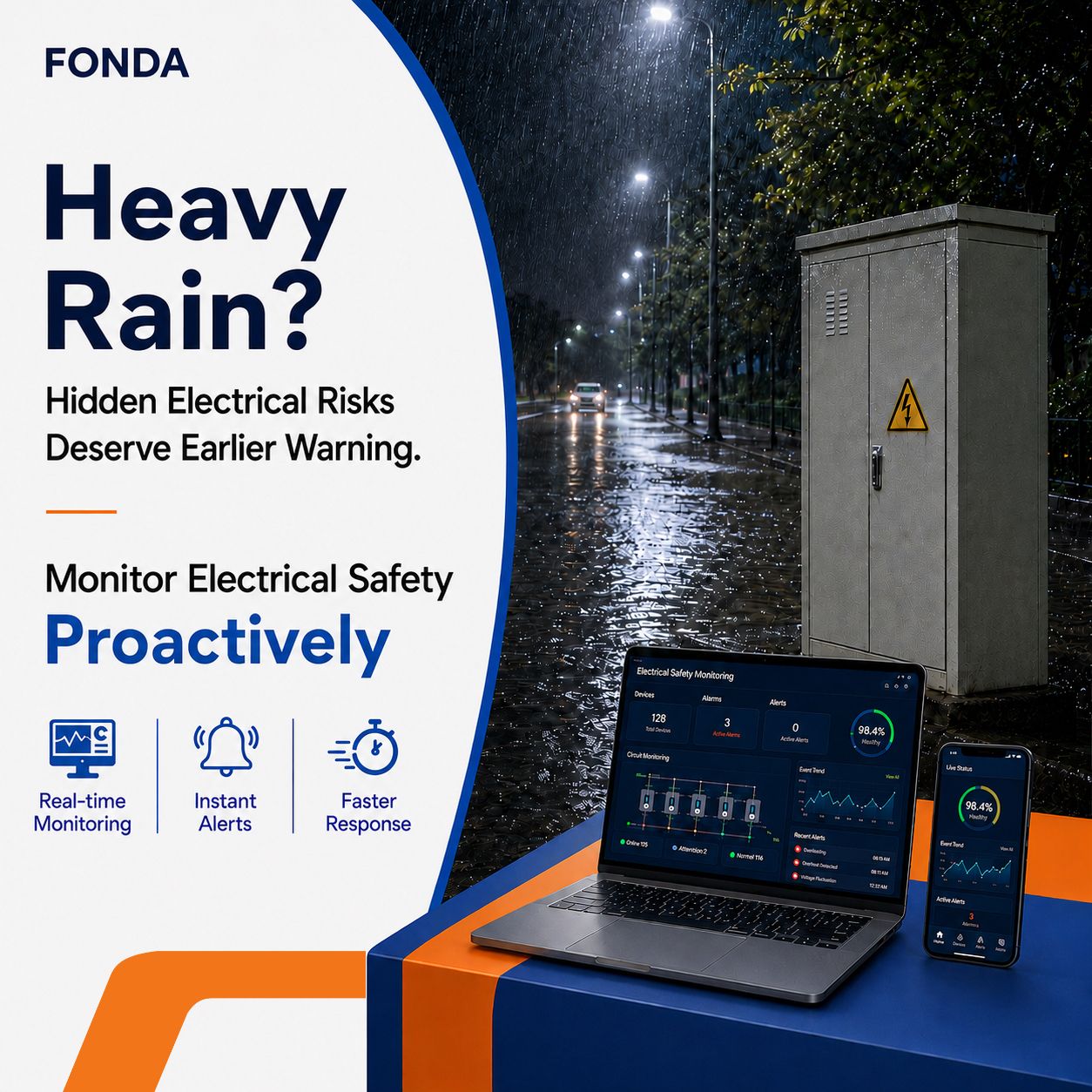 Extreme Weather Electrical Safety Monitoring | Urban Infrastructure Risk Solution
 FONDA Smart Lighting Project Improves Road Safety in El Salvador




