Remote switching and dimming are important features of smart street lighting. But are they enough to make a lighting network truly intelligent?
For cities, municipalities, and lighting operators managing thousands of streetlights, effective lighting management requires more than basic remote control. It also involves centralized monitoring, fault detection, energy analysis, and efficient maintenance.
So, what should a truly effective smart lighting system offer?
Remote lighting control allows operators to switch streetlights on or off and adjust brightness without visiting each location.
Smart lighting management goes further. It connects lighting devices, communication networks, and management platforms to provide a comprehensive view of the entire lighting network.
Instead of simply controlling individual lights, operators can monitor device status, analyze operating data, identify faults, and manage lighting assets through one centralized platform.
The key difference is that remote control focuses on operating lights, while smart lighting management focuses on managing the entire lighting network.
When a city operates thousands of streetlights across different areas, checking each device individually becomes inefficient.
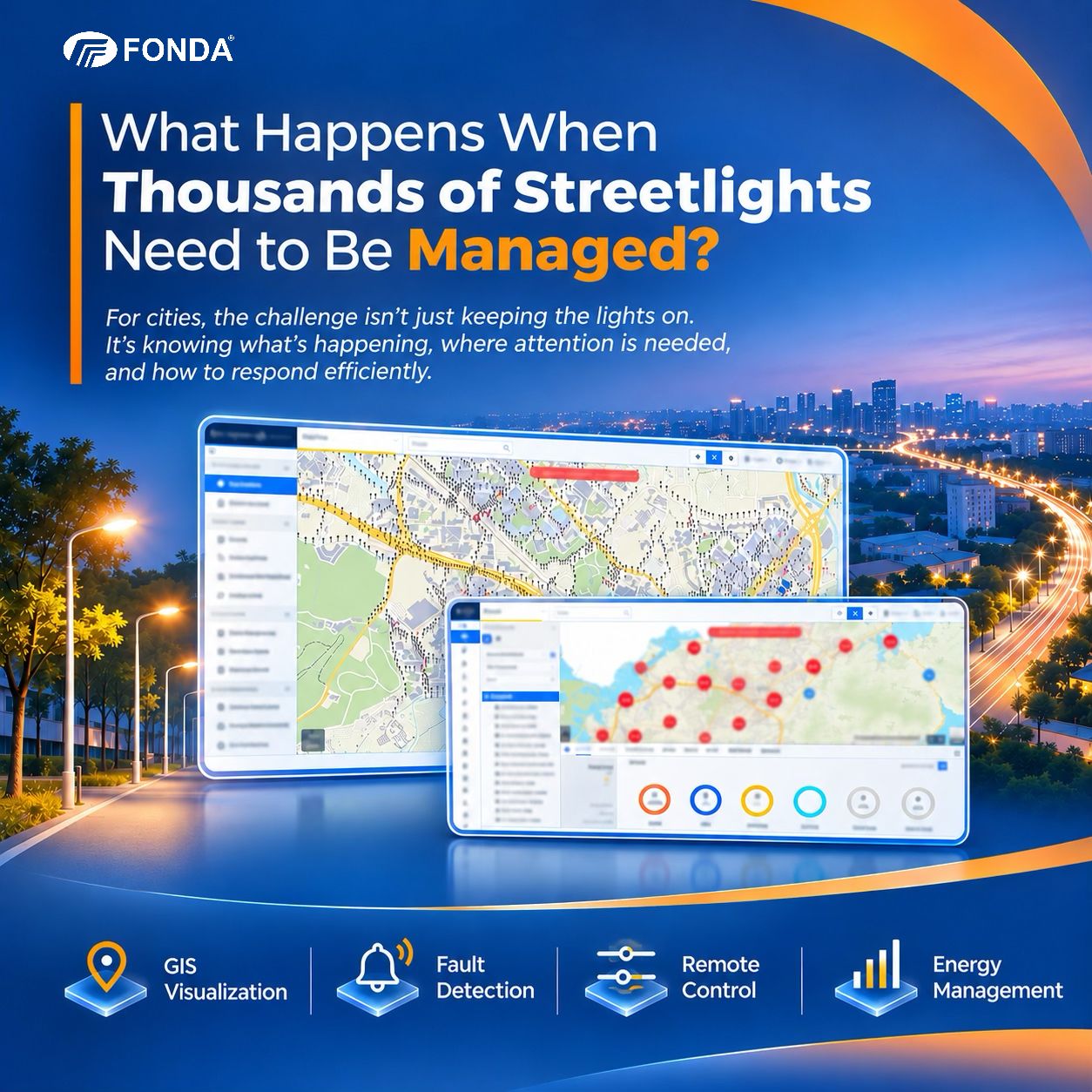
A centralized smart street lighting management system allows operators to monitor connected lighting assets through a single platform.
With GIS-based visualization, operators can:
Locate individual streetlights on a digital map.
View device connection and operating status.
Identify lighting assets across different areas.
Monitor the overall condition of the lighting network.
This provides better visibility and makes large-scale street lighting operations easier to manage.
Traditional street lighting maintenance often depends on manual inspections or reports from residents. As a result, faults may remain unnoticed for extended periods.
A smart street lighting system can monitor device operating conditions through connected controllers and generate alerts when supported monitoring functions detect abnormalities.
Depending on the controller configuration, monitored conditions may include:
Communication failures.
Luminaire faults.
Overcurrent and overvoltage.
Abnormal power factor.
Other supported device operating abnormalities.
By identifying affected devices and their locations, operators can prioritize maintenance tasks and improve response efficiency.
Yes. Smart lighting systems can support energy optimization through remote dimming, scheduled control, and energy monitoring.
Operators can configure lighting schedules according to different time periods and project requirements. They can also monitor electricity consumption and review operating data to identify opportunities for improvement.
For projects equipped with appropriate sensors, lighting levels can also be adjusted according to traffic or pedestrian activity.
The combination of intelligent control, scheduled dimming, and energy analysis helps reduce unnecessary energy consumption while maintaining appropriate lighting conditions.
Managing lighting assets, fault alerts, and energy data across separate systems can make maintenance more complicated.
A centralized platform integrates these functions into one management environment.
Operators can quickly identify where a problem has occurred, review device information, assess maintenance priorities, and coordinate responses.
This data-driven approach reduces reliance on manual inspections and helps improve the efficiency of long-term lighting network operations.
When evaluating a smart street lighting solution, cities and lighting operators should consider several key capabilities:
Centralized Management: Can the platform manage thousands of lighting assets through one interface?
GIS Visualization: Can operators locate and monitor individual streetlights?
Remote Control: Does the system support individual and group switching and dimming?
Fault Monitoring: Can it detect supported abnormal conditions and generate timely alerts?
Energy Analysis: Does it provide electricity consumption monitoring and operational data?
Flexible Communication: Can it support different communication technologies according to project requirements?
Scalability: Can the system adapt to future network expansion?
Choosing the right combination of controllers, communication technologies, and management software is essential for building a reliable smart lighting network.
The FondaCity AIoT Platform integrates lighting control, device monitoring, energy management, and operational analysis into one centralized management environment.
FONDA's smart lighting solutions combine intelligent single-lamp controllers, wireless communication technologies, and centralized management software to support different project requirements.
Key capabilities include:
GIS-Based Asset Visualization: Locate and manage lighting assets across the network.
Remote Lighting Control: Switch individual streetlights on or off and adjust brightness remotely.
Device Status Monitoring: Monitor communication and operating conditions of connected controllers.
Fault Alerts: Receive notifications about supported device and lighting abnormalities.
Energy Management: Monitor energy consumption and analyze lighting operation data.
Intelligent Scheduling: Configure lighting schedules and dimming strategies to support energy optimization.
With flexible communication options, including LTE CAT.1 and LoRa-based networking, FONDA provides solutions for different smart lighting project architectures.
By connecting field controllers, communication networks, and the FondaCity AIoT Platform, FONDA helps municipalities, lighting contractors, and urban infrastructure operators build more visible, manageable, and efficient street lighting networks.
Remote control is an important starting point, but it is not the ultimate goal of smart street lighting.
A truly effective system should help operators understand the entire network, detect problems earlier, optimize energy consumption, and make better maintenance decisions.
With the FondaCity AIoT Platform, FONDA brings connected lighting devices, communication technologies, and centralized management together to support smarter, more efficient, and more sustainable urban lighting operations.
Looking for a smart street lighting solution for your next project?
Contact FONDA to explore our smart lighting controllers and AIoT management platform.

 Smart Street Lighting Management for Smart Cities
 Smart Lighting for Golf Courses: Enhancing Night Golf Experiences