

One Pole, Muti-functional · One Network, Full Control
Smart Pole City IoT Solution
Using urban road lighting poles as the carrier, the solution integrates adaptive lighting, environment monitoring, video surveillance, information display, emergency help, broadcasting, Wi-Fi hotspots and EV charging — eight functions on a "mount-on-demand, power-on-demand, unified access" city sensing network. The pole body is designed waterproof, dustproof, anti-corrosion and lightning protection, suitable for stable all-weather operation in different climates.
8
Core Functions
IP65+
Protection Rating
1
Unified Platform
Eight Core Function Modules
Modular mounting — combine and expand on demand
Smart Lighting
LED lamps with smart nodes adjust brightness adaptively according to traffic, pedestrian flow and time of day, significantly reducing energy use.
Environment Monitoring
Real-time air quality, wind, temperature and noise data supporting resident alerts, pollution monitoring, winter road maintenance and driver warnings.
Video Surveillance
1080P@30fps HD camera for live-stream monitoring, extensible to traffic data collection, violation capture, smart parking and face recognition.
Broadcasting
Background music, emergency alerts and public announcements with remote automatic task scheduling for precise, timed playback.
Information Display
LED screen delivers traffic guidance, emergency notifications and public information, plus dynamic commercial advertising.
Emergency Help
Two-way voice and video connection between citizens and the call center enables minute-level rapid response in emergencies.
EV Charging
Charging pile powered by the street light grid, with operating status monitored in real time on the Smart Pole Management Platform.
Wireless Wi-Fi
Wireless APs provide free or paid Wi-Fi hotspot services to citizens, extending public network coverage.
Architecture: Cloud – Network – Edge – Device
Unified platform access — one data network, one management screen
Cloud Platform
Smart Pole Management Platform
- · Unified device access & remote O&M
- · EV charger status monitoring
- · Remote scheduling of broadcast & screen content
- · Visualization dashboards & alerting
Network
Transmission & Networking
- · 4G
- · Wi-Fi hotspot coverage
- · Secure video upload
Edge
Smart Pole Gateway
- · Multi-protocol device aggregation
- · Edge computing & local linkage
- · Store-and-forward & remote upgrade
- · Power metering & safety protection
Device
Pole-Mounted Equipment
- · Smart lamp / single-lamp controller
- · Camera / environment sensors
- · LED display / broadcast / SOS terminal
- · Wi-Fi AP / EV charging pile
Typical Application Scenarios
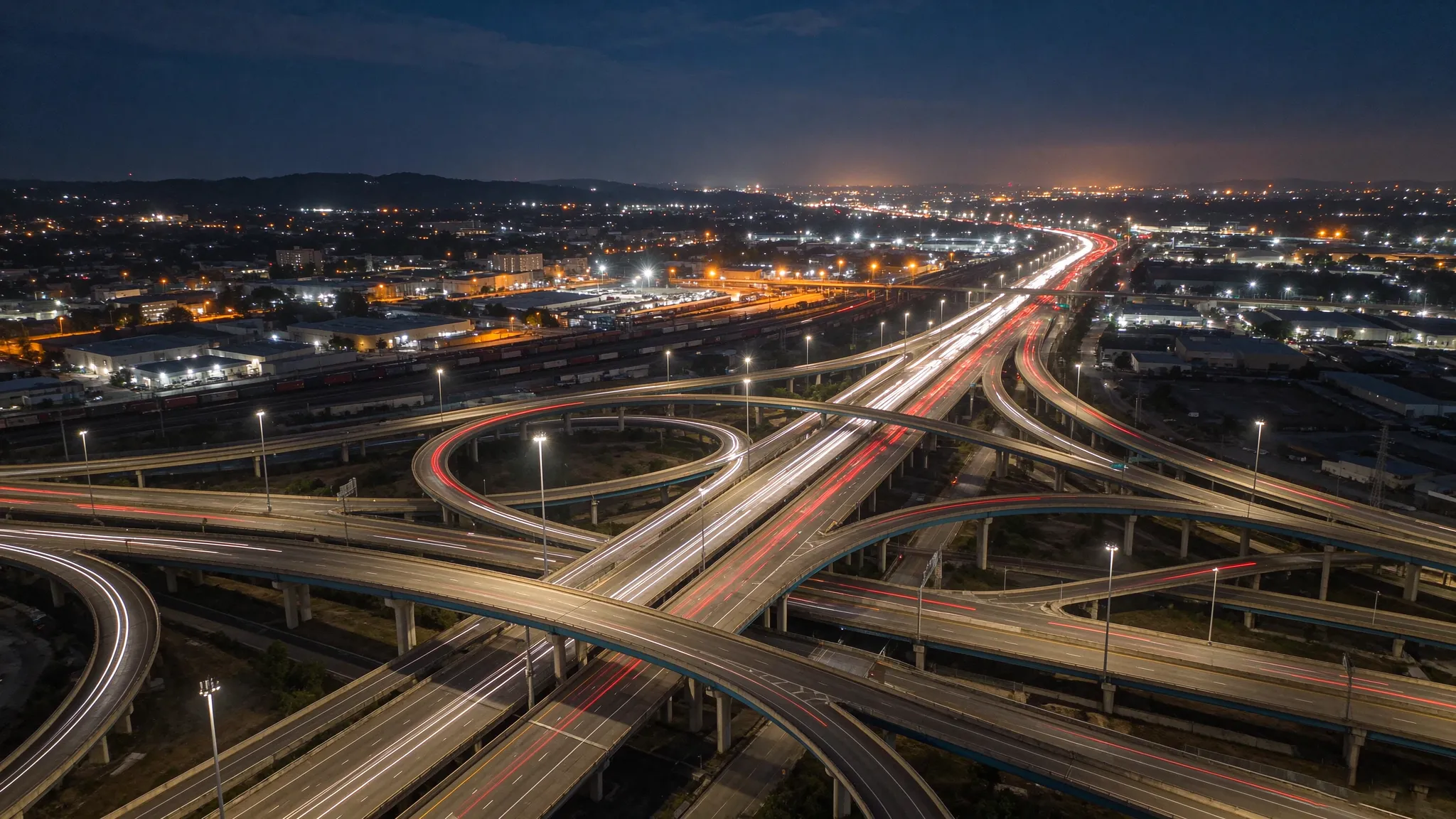
Urban Arterial Roads
Adaptive lighting + traffic data collection + violation capture, easing congestion and improving road safety.

Parks & Public Squares
Background music + information display + free Wi-Fi + SOS terminals for a safer, richer public experience.

Industrial Parks & Scenic Areas
Surveillance + emergency broadcast + environment monitoring + EV charging — one-stop smart park management.

Smart Campuses & Commercial Districts
SOS terminals + video security + information display + Wi-Fi coverage to protect students and energize retail footfall.
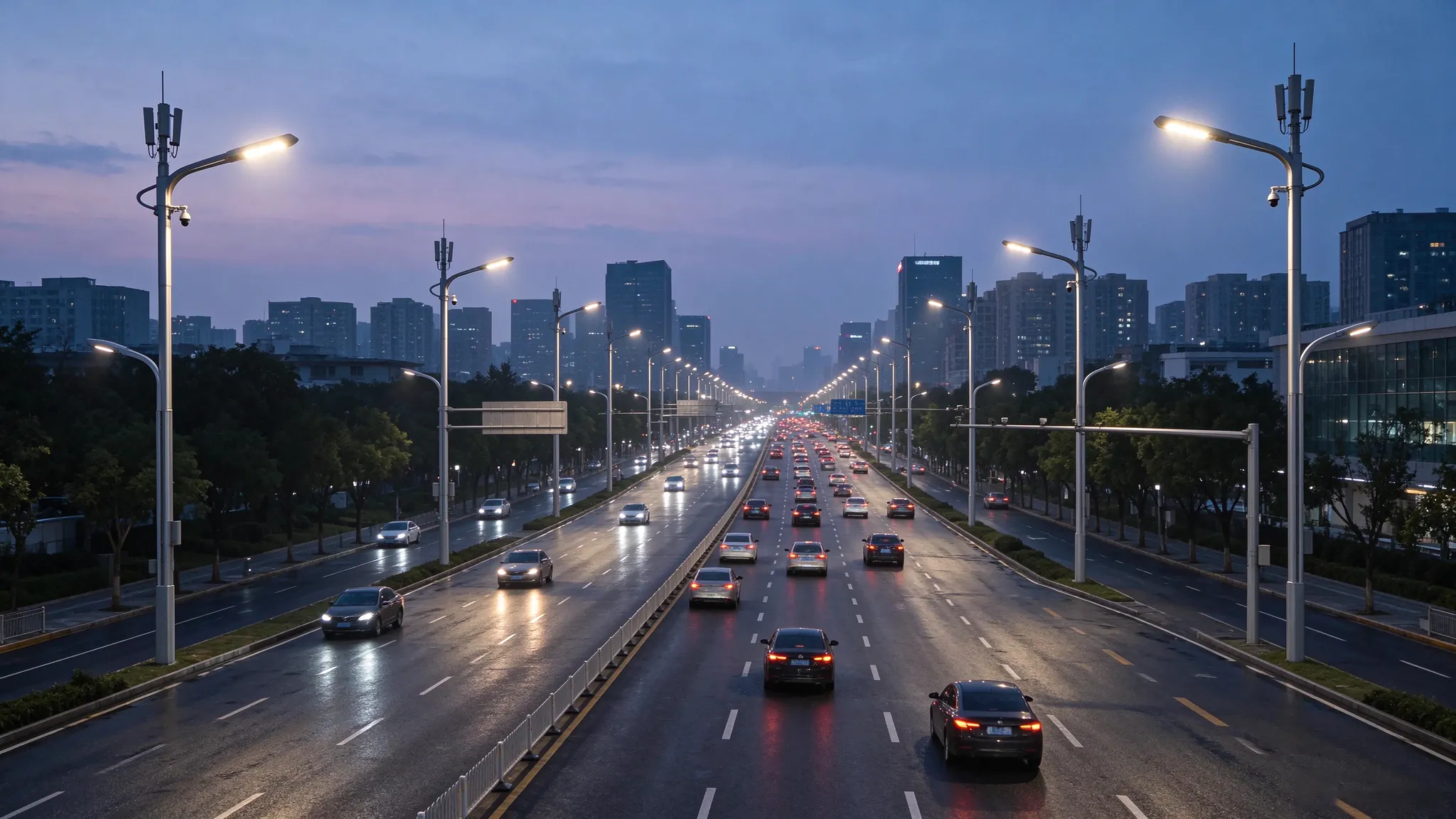
Highways & Transport Hubs
All-weather lighting + traffic incident detection + variable message display + emergency broadcast for high-volume corridors.


Ports & Logistics Parks
Anti-corrosion, lightning-proof design for coastal environments; monitoring + sensors + charging for 24/7 operational safety.
Measurable Returns
Returns come from three sources: lighting energy savings, more efficient operations, and avoided duplicate construction through shared pole assets.
60–70%
Lighting energy savings
Typical savings when LED retrofit is combined with scheduled dimming and on-demand lighting, versus always-on circuits.
30–50%
Fewer street poles
Shared poles across systems cut duplicate poles, foundations and trenching.
Minutes
Fault detection speed
Manual patrols replaced by proactive alerts that pinpoint pole, luminaire and circuit.
8+
Capacity per pole
Reserved load and interfaces let new modules be added later, protecting the original investment.
Figures are typical project ranges. Actual savings and pole reduction depend on existing luminaires, road conditions and project scope, and should be confirmed by on-site measurement.
Conventional Poles vs. Smart Poles
The difference is not how many devices are bolted on, but whether power, connectivity and operations share one foundation.
Table 1 · Construction and operations compared
| Dimension | Conventional pole | Smart pole |
|---|---|---|
| Functions | Lighting only; every other service needs its own pole | Lighting plus 7 or more services on one pole |
| Dimming control | Timer or manual circuit switching | Stepless per-luminaire dimming with adaptive triggers |
| Fault detection | Manual patrols and public reports | Proactive alerts pinpointing the exact pole and luminaire |
| Power and conduit | Repeated trenching and cabling for each system | One installation, shared power distribution and fiber |
| Data value | Little or no data captured | Continuous energy, environment, footfall and event data |
| Future expansion | Costly retrofits and fresh construction | Reserved interfaces and load capacity for modular add-ons |
| Operations | Multiple vendors, platforms and contacts | One platform, one ticketing flow, one SLA |
Key Configuration & Specifications
| Pole Body | 8 m Q235 steel pole with waterproof, dustproof, anti-corrosion and lightning protection design for varied climates |
| Smart Lighting | 120W LED street lamp + smart node with adaptive dimming by traffic and time of day |
| Video Surveillance | 1080P@30fps HD camera with live streaming and smart application extensions |
| Environment Monitoring | All-in-one weather sensor for air quality, wind speed, temperature and noise |
| Information Display | LED display supporting traffic guidance, emergency notices and dynamic advertising |
| Public Services | Emergency help terminal (two-way voice & video), broadcasting speaker, free/paid Wi-Fi AP |
| EV Charging | 220VAC EV charging pile reusing the street light grid, status integrated into the platform |
* Standard configuration shown. Module combinations can be customized per project — contact us for a tailored smart pole solution.
Frequently Asked Questions
Can existing poles be upgraded, or do they have to be replaced?+
Not necessarily. There are usually two routes: retrofit, where existing poles pass a structural and corrosion check before receiving a cabinet, luminaire controller and edge gateway; or full replacement, for aged poles, insufficient load capacity or new roads needing Fiber optic cable or 4G network provision. After the survey we provide a pole-by-pole retrofit-or-replace list rather than a blanket decision.
If the network or power fails, do lighting and alerts stop too?+
Critical policies run locally on the pole gateway. If the network drops, downloaded dimming calendars and local alert logic keep working, data is buffered and syncs automatically on recovery.
How do we choose a communication protocol and integrate with existing city platforms?+
Selection follows site conditions: PLC where existing power cables make new wiring impractical; LoRaWAN for wide, low-density sites such as parks; LTE-CAT.1 for plug-and-play urban streets without a private network; off-grid solar where mains power is absent or carbon targets matter. Protocols can also be mixed by road section. The platform provides RESTful / MQTT interfaces and data push, with GB/T 28181 and ONVIF for video, and maps fields to the receiving platform data dictionary. Permissions are role-based, cross-department data is shared by catalogue, and all actions are logged.
How is video and sensor data kept secure?+
We recommend a dedicated, isolated video network with encrypted links and authenticated device onboarding. The platform adds tiered permissions, audit trails and log retention, and can be hardened to meet applicable cybersecurity classification requirements. The permitted use of personal data and public-space imagery should be defined in the project contract.
How is payback calculated?+
Usually three parts: electricity savings, labour saved on patrols and tickets, and duplicate infrastructure avoided by sharing poles. Projects with a commercial operating model can also count pole leasing, display advertising or charging revenue. We build a project-specific model from existing lamp wattage, operating hours, tariff, pole count and maintenance staffing rather than quoting a generic payback period.
Four-Step Delivery Path
Site Survey
On-site survey of pole positions, power and network conditions to define the module combination.
Solution Design
Pole structure, load and power capacity design with detailed drawings and a configuration list.
Production & Installation
Factory prefabrication of the pole and equipment, followed by foundation works, erection and commissioning.
Platform Handover
Platform deployment, device onboarding, operator training and ongoing remote support.
Send us your site conditions.
Get a buildable specification.
Share the basics of your project and site conditions. We will return pole recommendations, a layout and an investment model based on your actual situation — not a templated quote.
- Road length, existing pole count and luminaire type
- Available power, conduit and network conditions
- New build or retrofit, and target schedule


